The short answer
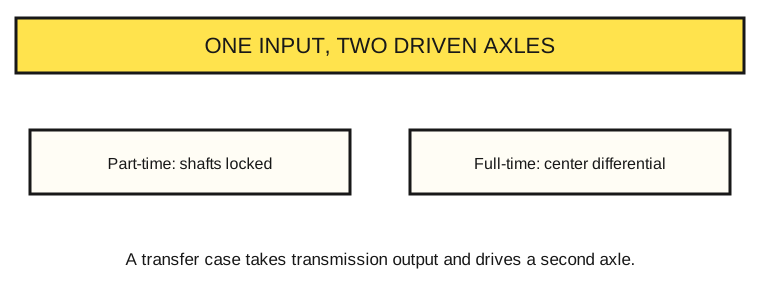
A transfer case is a gearbox behind the transmission that sends power to a second axle. In a part-time four-wheel-drive truck it locks the front and rear driveshafts together and can add a low range. In a full-time or automatic system, a center differential or a clutch lets the two axles turn at different speeds. Many crossovers use a smaller unit without driver-selected modes.
One input, two outputs
The transmission sends its output into the transfer case. Inside, a chain or a gear set drives a second output shaft. One shaft goes to the rear axle and the other to the front axle. Each axle still has its own differential between its two wheels.
Ford’s description of its part-time system is a clear example. In 2H, power goes to the rear wheels only. In 4H, the transfer case mechanically interlocks the front and rear driveshafts so that both axles receive power. Ford calls this a two-speed transfer case because it also offers a low range.
A full-time all-wheel-drive car uses a different arrangement. Subaru’s description of its system has power at both axles all the time, with no mode for the driver to select. The work of dividing power happens inside the unit.
Sources: Ford Motor Company ↗ · Subaru of America ↗
Why locked four-wheel drive is not for dry pavement
In a turn, the front wheels follow a wider path than the rear wheels. The front driveshaft must turn slightly faster than the rear. A part-time transfer case in 4H locks the two shafts together, so they cannot differ. Something must give.
On snow, sand, or mud, the tires slip a little and release the difference. On dry pavement, the tires grip, and the driveline winds up instead. Ford states that 4H is not intended for use on dry pavement. The reason is this binding, which stresses the transfer case, the axles, and the tires.
A center differential solves the problem the same way an axle differential does between two wheels. Eaton’s explanation of an open differential applies: it lets two outputs turn at different speeds while both receive torque. That is why a full-time system can run on dry roads.
Sources: Ford Motor Company ↗ · Eaton ↗
Low range multiplies torque
4L adds a second gear reduction inside the transfer case. Ford describes it as locked four-wheel drive with additional gearing for increased torque. The wheels turn more slowly for a given engine speed, and the turning force at the wheels rises in the same proportion. The gear-ratio arithmetic is the same as in the transmission.
Ford names the uses: deep sand, steep grades, and pulling heavy objects. It also describes the procedure. The transmission goes into Neutral before the shift to 4L. The shift must not happen while the rear wheels slip or while the vehicle accelerates. Low range is a tool for slow work, not a mode for the road.
Sources: Ford Motor Company ↗ · University of California San Diego ↗
Automatic modes and crossovers
Ford’s 4A mode is electronically controlled four-wheel drive. The on-demand transfer case uses sensor inputs to decide how much torque goes to the front wheels, and Ford describes it for varied road conditions. The driver does not need to choose when the surface changes.
Many crossovers and sedans with all-wheel drive follow the automatic idea without a selectable transfer case. Subaru’s system keeps both axles engaged all the time. Other designs send power to the second axle through a clutch when the system detects slip. The badge says AWD in both cases. The manual says how the system behaves, and whether it has any mode for the driver.
Sources: Ford Motor Company ↗ · Subaru of America ↗
Common misunderstandings
All-wheel drive and four-wheel drive are not two names for the same thing. A part-time 4WD system has modes and a low range and needs a slippery surface in 4H. A full-time AWD system runs on any surface without a selection.
Driven wheels help the car move. They do not help it stop. Braking and cornering depend on the tires and the brakes, which are the same four contact patches in any mode. A 4WD badge does not shorten a stopping distance on ice.
4L is not an extra-grip mode for a wet highway. It is a slow, high-torque mode for off-road work. Ford’s description reserves it for deep sand, steep grades, and pulling heavy objects.
Sources: Ford Motor Company ↗ · Subaru of America ↗ · National Highway Traffic Safety Administration ↗
Questions people ask
Is AWD the same as 4WD? No. AWD usually describes a full-time or automatic system with no modes. 4WD usually describes a part-time system with 2H, 4H, and 4L.
Can I use 4H on a wet highway? Ford says 4H is for off-road or winter conditions such as deep snow, sand, or mud, and not for dry pavement. For varied on-road conditions, Ford describes 4A.
When do I use 4L? For slow, high-torque work: deep sand, steep grades, pulling heavy objects. Shift with the transmission in Neutral and the vehicle moving slowly or stopped, as the manual describes.
Do I need 4WD in snow? It helps the car start moving on a slippery surface. Winter tires change what the car can do in every direction, including stopping. Decide on tires first, then on the drive system.
Sources: Ford Motor Company ↗ · National Highway Traffic Safety Administration ↗
Front-wheel drive in a Michigan winter, and a Charger in a parking lot
I have never owned an all-wheel-drive car. The Sienna was front-wheel drive. Fifi is front-wheel drive. The Odyssey is front-wheel drive.
Where AWD helps. In my experience, it helps you get moving from a dead stop on icy pavement. Other than that, front-wheel drive is fine for city driving, even with snow. I have not felt stuck without it.
The Charger. I used to own a rear-wheel-drive Dodge Charger. That car could let you have fun in a snowy parking lot doing donuts. Same traction story, told from the other end of the car.
What mattered more. Good tires. When I put all-weather tires on Fifi, modest snow got much easier, and nothing about the drive system changed. Tires first, then worry about which wheels are driven.
Sources & review
Reviewed . Original educational explanation, checked against the sources below. This is general guidance; consult the documents for the exact vehicle, year, configuration, and market.
- Drive with Four WheelsFord Motor Company · owner support · Definitions of 2H, 4A, 4H and 4L; 4H not intended for dry pavement; 4L adds gearing for increased torque; part-time two-speed transfer case mechanically interlocks the front and rear driveshafts; on-demand transfer case uses sensor inputs; shift to 4L with the transmission in Neutral. · Accessed 2026-11-05.
- What is All-Wheel Drive (AWD)?Subaru of America · How does AWD Work? · Accessed 2026-10-22.
- What is an open differential?Eaton · What is an open differential?; Advantages. Simplified torque-to-least-resistance wording is not adopted. · Accessed 2026-10-22.
- Gear RatiosUniversity of California San Diego · MAE 3 · Energy and Power Equations; Analysis of a Gear Pair; Summary. Mathematical facts only; no teaching artwork or exercise adapted. · Accessed 2026-10-22.
- Buying a Used Car From a DealerFederal Trade Commission · Do Some Homework; Get an Independent Inspection Before You Buy; The Buyers Guide · Accessed 2026-10-22.
- Do I need new tires? Performance upgradeMichelin USA · Plus sizing and manufacturer-approved alternative wheel diameters. No general tire upgrade recommendation adopted. · Accessed 2026-10-23.
- Winter Weather Driving TipsNational Highway Traffic Safety Administration · Tires; Tire pressure; Before You Go. Federal consumer education used as factual base; no photos or text reproduced. · Accessed 2026-10-23.