The short answer
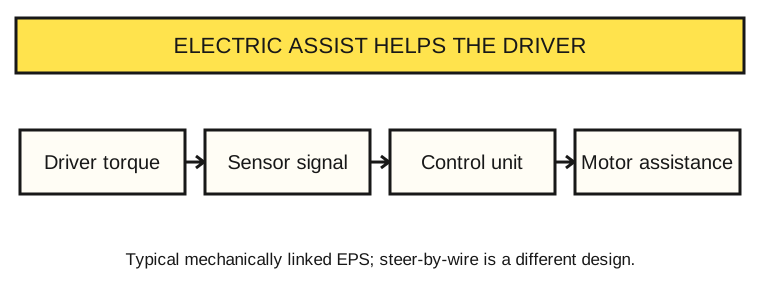
Electric power steering, abbreviated EPS, uses an electric motor to assist steering. Sensors report the driver’s steering effort, and a controller requests suitable motor assistance. In a common mechanically linked system, the steering wheel still connects to the steering mechanism. Steer-by-wire is a different arrangement and needs its own explanation.
A motor adds assistance to a steering request
Turning the steering wheel applies torque, meaning a turning effect. A sensor detects the steering input. The electronic controller processes that information and operates a motor to help move the steering mechanism. The assistance reduces the effort the driver needs to supply.
The motor can act through different arrangements, such as the steering column or rack. Bosch’s column-assist example retains mechanical rack-and-pinion steering. That particular layout illustrates a principle, rather than proving every electric steering system uses the same parts or mounting position.
Sources: Robert Bosch Automotive Steering ↗ · NASA Glenn Research Center ↗
Assistance and directional control are different questions
The tires still need grip to change the car’s direction. An assist motor does not remove the limits of the road surface, tire condition, or suspension geometry. A light steering wheel is therefore not evidence that the car can corner safely at any speed.
Some driver-assistance features can request steering intervention, but their capabilities and limits depend on the fitted system. The presence of electric assistance alone does not establish lane centering or automated driving. Read the vehicle’s equipment list and manual instead of inferring capabilities from the steering technology’s name.
Sources: National Highway Traffic Safety Administration ↗ · National Highway Traffic Safety Administration ↗ · Robert Bosch Automotive Steering ↗
Common misunderstandings
Electric steering does not mean the whole car is electric. Gasoline, diesel, hybrid, and battery-electric cars can use it. It describes steering assistance, not the propulsion energy source.
Do not assume a hydraulic power-steering-fluid service applies to an all-electric assistance mechanism. Equally, an absence of that fluid does not make the steering maintenance-free. Identify the actual design, required checks, and any model-specific calibration after repairs. Comparing steering feel is useful, but a personal preference for heavier effort is not an inspection result.
Sources: Robert Bosch Automotive Steering ↗ · Ford UK ↗ · Federal Trade Commission ↗
Sources & review
Reviewed . Original educational explanation, checked against the sources below. This is general guidance; consult the documents for the exact vehicle, year, configuration, and market.
- Servolectric electric power steering systemRobert Bosch Automotive Steering · PDF pages 6-7, Servo unit on the steering column: Task and Operating principle. Historical product example, no current availability or efficiency claim. · Accessed 2026-10-23.
- Torque (Moment)NASA Glenn Research Center · Definition of torque and perpendicular lever arm · Accessed 2026-10-22.
- Tire Safety Ratings and Awareness · TireWiseNational Highway Traffic Safety Administration · Tire Maintenance; Tire Pressure; Aging · Accessed 2026-10-22.
- Driver Assistance TechnologiesNational Highway Traffic Safety Administration · Tech Overview; Collision Warning; Collision Intervention; Driving Control Assistance · Accessed 2026-10-22.
- Buying a Used Car From a DealerFederal Trade Commission · Do Some Homework; Get an Independent Inspection Before You Buy; The Buyers Guide · Accessed 2026-10-22.
- What You Need to Know About Tire AlignmentBridgestone Americas · What is tire alignment?; Camber, toe and caster; Tire balancing. Generic intervals and single-cause symptom diagnoses are not adopted. · Accessed 2026-10-22.
- Instrument Cluster — Warning Lamps and IndicatorsFord Motor Company · online owner manual · Warning Lamps and Indicators; Engine Oil Warning Lamp; Malfunction Indicator Lamp; Scheduled Maintenance Indicator Lamp · Accessed 2026-10-22.
- Service Intervals and Oil Change IntervalsFord UK · When should I get my car serviced?; variable oil service intervals · Accessed 2026-10-22.