The short answer
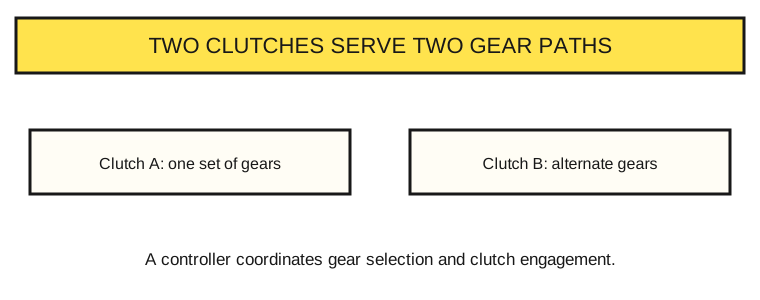
A dual-clutch transmission, or DCT, uses two clutches serving separate gear paths. Controls can prepare a likely next gear on one path while the other carries drive. Coordinating clutch engagement changes the active path. The design and calibration affect behavior; the label does not guarantee a particular shift feel or service life.
Two paths let the controls prepare a gear
A conventional manual has a driver-operated clutch and gear selection. A dual-clutch automatic uses controls to coordinate two clutches and its gear mechanism. One clutch serves one set of ratios, while the other serves alternate ratios. The exact allocation and construction depend on the transmission.
The controls can preselect a likely next ratio on the inactive path. A change then involves releasing one clutch and engaging the other in a coordinated way. Preselection helps explain how the design can shift quickly. It does not mean every requested ratio is always ready or that every shift happens without any perceptible change.
Sources: Volkswagen India ↗ · ZF Aftermarket / SACHS ↗
Starting still requires managing a speed difference
At rest, a running combustion engine and stationary driven wheels have different rotational speeds. The coupling must manage that difference as the car moves away. A controlled friction clutch can slip during this transition, just as friction coupling allows a manual car to start smoothly.
Slip produces heat, so the controls and permitted operating methods matter. Read the manual’s instructions for slow traffic, hills, parking, and warnings. Do not transfer a technique from a torque-converter automatic simply because both cars have similar selector positions. Different designs can need different driver actions.
Sources: ZF Aftermarket / SACHS ↗ · Volkswagen India ↗ · Kia, 2025 DL3 online owner manual ↗
Common misunderstandings
DCT describes a family of mechanisms, not a universal reliability ranking. Different versions, years, software, usage, and servicing can produce different ownership experiences. A failure story about another transmission is not a diagnosis of this one.
Fast gear changes do not replace a suitable overall vehicle comparison. Consider smoothness in your actual use, maintenance evidence, and inspection findings. A seller calling a warning ‘normal for these’ should still explain it using the correct vehicle information and any documented diagnosis.
Sources: Volkswagen India ↗ · Federal Trade Commission ↗ · Ford UK ↗
Sources & review
Reviewed . Original educational explanation, checked against the sources below. This is general guidance; consult the documents for the exact vehicle, year, configuration, and market.
- Innovations & Technology — Power & EfficiencyVolkswagen India · DSG: two clutches, input shafts and preselection. Instant-shift and reliability marketing claims excluded. · Accessed 2026-10-23.
- Clutches for Passenger Cars and Light Commercial VehiclesZF Aftermarket / SACHS · Clutch disks; XTend clutch pressure plate; Function of the master/slave cylinder; Function of the clutch actuation system with cable control · Accessed 2026-10-22.
- Dual clutch transmission — DCT warning messagesKia, 2025 DL3 online owner manual · Steep-grade and temperature warnings. A model-specific example of operating restrictions, not universal DCT instructions. · Accessed 2026-10-23.
- Buying a Used Car From a DealerFederal Trade Commission · Do Some Homework; Get an Independent Inspection Before You Buy; The Buyers Guide · Accessed 2026-10-22.
- Service Intervals and Oil Change IntervalsFord UK · When should I get my car serviced?; variable oil service intervals · Accessed 2026-10-22.