The short answer
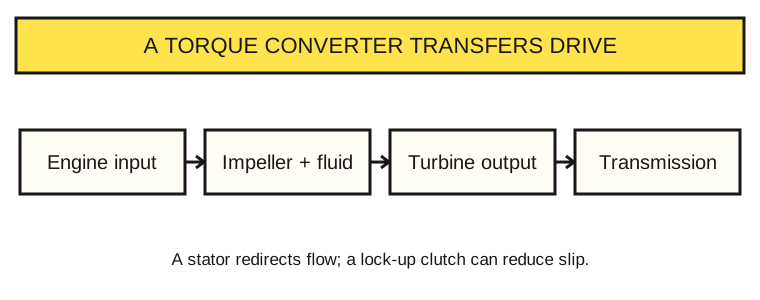
A torque converter transfers drive through moving fluid between an engine and transmission. Its engine-driven impeller moves fluid toward a turbine connected to the transmission input. A stator redirects returning flow. Many designs also use a lock-up clutch to reduce slip in suitable conditions. Not every automatic transmission uses a torque converter.
Moving fluid carries drive between rotating parts
The impeller turns with the engine side of the assembly. It directs fluid toward the turbine, which transfers rotation toward the transmission. The fluid path allows the input and output to rotate at different speeds. This helps a conventional automatic car remain stationary with its engine running while the driver applies the brake.
The stator redirects fluid returning from the turbine. Under suitable conditions, this supports torque multiplication. That does not create free power: the relationship involves speed differences and losses. The converter’s behavior changes with operating conditions rather than multiplying torque by one fixed amount at all times.
Sources: TCI Automotive / Edelbrock Group ↗ · University of California San Diego ↗
A lock-up clutch reduces the need for fluid slip
Slip is useful during starting and other transitions, but it can also turn energy into heat. A lock-up clutch can establish a more direct connection when the controls permit. Many modern converters combine this clutch with damping to manage vibration.
The points at which the clutch applies, releases, or operates with controlled slip depend on the design and calibration. ZF’s product information illustrates one arrangement, not a rule for every automatic. A small engine-speed change therefore needs context before it can be labeled normal operation or a fault.
Sources: ZF ↗ · TCI Automotive / Edelbrock Group ↗
Common misunderstandings
Automatic describes how driving ratios are managed, not one universal internal mechanism. Some automatics use other clutch arrangements, while some continuously variable transmissions also use a torque converter. The driving selector alone cannot identify the hardware.
Creeping forward at idle does not prove that every automatic should behave identically. Controls and coupling designs differ. Compare the actual car with its own instructions and expected operation, and keep condition findings separate from your preference for a particular driving feel.
Sources: U.S. Environmental Protection Agency ↗ · Honda Motor Co. ↗ · TCI Automotive / Edelbrock Group ↗ · Federal Trade Commission ↗
Sources & review
Reviewed . Original educational explanation, checked against the sources below. This is general guidance; consult the documents for the exact vehicle, year, configuration, and market.
- Torque Converters ExplainedTCI Automotive / Edelbrock Group · Impeller Pump; Stator; Cover; introductory turbine and fluid-coupling explanation. Racing advice excluded. · Accessed 2026-10-23.
- Gear RatiosUniversity of California San Diego · MAE 3 · Energy and Power Equations; Analysis of a Gear Pair; Summary. Mathematical facts only; no teaching artwork or exercise adapted. · Accessed 2026-10-22.
- Torque ConverterZF · Hydrodynamic circuit, lock-up clutch and damping. TwinTD product advantages not generalized. · Accessed 2026-10-23.
- Buying a Used Car From a DealerFederal Trade Commission · Do Some Homework; Get an Independent Inspection Before You Buy; The Buyers Guide · Accessed 2026-10-22.
- Service Intervals and Oil Change IntervalsFord UK · When should I get my car serviced?; variable oil service intervals · Accessed 2026-10-22.
- Advanced Gasoline and Diesel VehiclesU.S. Environmental Protection Agency · Turbocharging and Advanced Transmissions · Accessed 2026-10-22.
- CVTHonda Motor Co. · A Transmission Contributing to Outstanding Fuel Efficiency and Smooth Driving · Accessed 2026-10-22.