The short answer
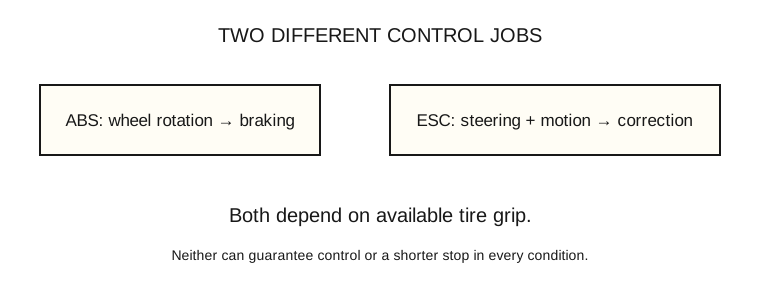
An anti-lock braking system adjusts brake pressure to help prevent wheel lock. Electronic stability control compares steering input with vehicle motion and can intervene to reduce an unwanted change of direction. Both depend on the grip available at the tires.
ABS manages wheel slip during braking
A rolling wheel can slow until it stops rotating while the vehicle still moves. This is wheel lock. An anti-lock braking system, usually called ABS, uses wheel-rotation information to detect when pressure needs adjusting. Its control hardware can reduce, hold, and increase braking pressure as needed.
The system works with the ordinary braking hardware. It does not replace sound brake components or suitable tires. It also does not promise the shortest stopping distance on every surface. The important principle is controlled braking behavior within the grip and conditions available, rather than an unlimited increase in grip.
Sources: National Highway Traffic Safety Administration ↗ · National Highway Traffic Safety Administration ↗
Stability control watches how the vehicle moves
Electronic stability control, abbreviated ESC, has a different aim. It uses information about steering and motion to assess whether the car is responding as intended. For example, the car may be rotating more or less than expected for the driver’s steering input.
The system can brake individual wheels, reduce drive power, or combine those actions to help correct the motion. Applying a brake at one wheel can create a turning effect on the vehicle. This is an intervention within physical limits. If speed and conditions demand more tire grip than exists, the system cannot guarantee control.
Sources: National Highway Traffic Safety Administration ↗ · Transport Canada ↗
Common misunderstandings
ABS and ESC are not different names for the same function. ABS controls wheel slip under braking. ESC addresses the relationship between the driver’s intended path and the vehicle’s motion, using brake and power interventions.
All-wheel drive does not replace either system. It describes which wheels can receive propulsion. Tire condition, road conditions, and safe driving still matter even when a car has several electronic control systems.
Sources: National Highway Traffic Safety Administration ↗ · Transport Canada ↗ · Subaru of America ↗
Sources & review
Reviewed . Original educational explanation, checked against the sources below. This is general guidance; consult the documents for the exact vehicle, year, configuration, and market.
- Automatic Emergency Braking Systems for Light Vehicles — Notice of Proposed RulemakingNational Highway Traffic Safety Administration · 2023 · Electronically Modulated Braking Systems, printed page 237 (PDF page index 236) · Accessed 2026-10-22.
- Tire Safety Ratings and Awareness · TireWiseNational Highway Traffic Safety Administration · Tire Maintenance; Tire Pressure; Aging · Accessed 2026-10-22.
- Electronic stability controlTransport Canada · How this technology works; Things for drivers to keep in mind · Accessed 2026-10-22.
- Instrument Cluster — Warning Lamps and IndicatorsFord Motor Company · online owner manual · Warning Lamps and Indicators; Engine Oil Warning Lamp; Malfunction Indicator Lamp; Scheduled Maintenance Indicator Lamp · Accessed 2026-10-22.
- Buying a Used Car From a DealerFederal Trade Commission · Do Some Homework; Get an Independent Inspection Before You Buy; The Buyers Guide · Accessed 2026-10-22.
- What is All-Wheel Drive (AWD)?Subaru of America · How does AWD Work? · Accessed 2026-10-22.