The short answer
A transmission transfers power to the wheels and provides a useful relationship between engine speed and wheel speed. Its ratios trade rotational speed for turning force.
Why one speed relationship is not enough
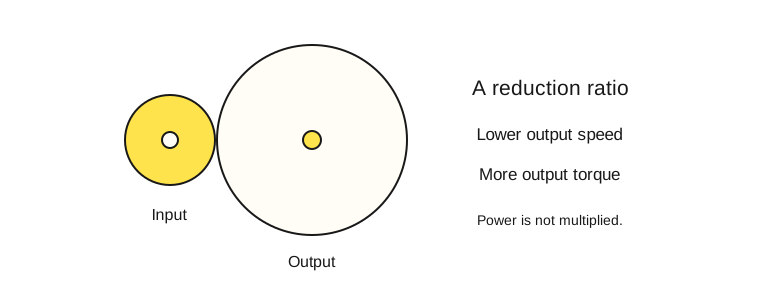
A combustion engine must keep turning while the car moves at many different road speeds. A low gear lets the engine turn several times for each turn farther along the drivetrain. This increases available turning force at the cost of output speed, which helps when moving off.
A higher gear lets the car travel faster for a given engine speed. Choosing the ratio can keep the engine in an appropriate operating range. Gears do not create extra power: real transmissions also lose some energy as heat.
Sources: U.S. Environmental Protection Agency ↗ · U.S. Department of Energy ↗
Common ways to choose the ratio
In a manual transmission, the driver selects gears and normally uses a clutch pedal to disconnect the engine briefly. A conventional automatic chooses its own ratios. Other automatic designs use different mechanisms, so the word “automatic” does not identify one construction.
A continuously variable transmission, or CVT, can vary its ratio without fixed steps. A common design uses a belt and adjustable pulleys. A hybrid transmission called an e-CVT may use a different arrangement entirely. The name alone does not establish that it contains a belt.
Sources: Honda Motor Co. ↗
Common misunderstandings
More gears do not automatically make one car better than another. Ratio selection, controls, condition, and suitability matter.
A CVT holding the engine at a steady speed while the car accelerates can be normal. An unfamiliar sensation should prompt a question rather than an immediate diagnosis.
Sources: Honda Motor Co. ↗
Sources & review
Reviewed . Original educational explanation, checked against the sources below. This is general guidance; consult the documents for the exact vehicle, year, configuration, and market.
- Advanced Gasoline and Diesel VehiclesU.S. Environmental Protection Agency · Turbocharging and Advanced Transmissions · Accessed 2026-10-22.
- How Do Gasoline Cars Work?U.S. Department of Energy · Alternative Fuels Data Center · Introduction and Key Components of a Gasoline Car · Accessed 2026-10-22.
- CVTHonda Motor Co. · A Transmission Contributing to Outstanding Fuel Efficiency and Smooth Driving · Accessed 2026-10-22.
- How Do All-Electric Cars Work?U.S. Department of Energy · Alternative Fuels Data Center · Introduction and Key Components of an All-Electric Car · Accessed 2026-10-22.
- Service Intervals and Oil Change IntervalsFord UK · When should I get my car serviced?; variable oil service intervals · Accessed 2026-10-22.