The short answer
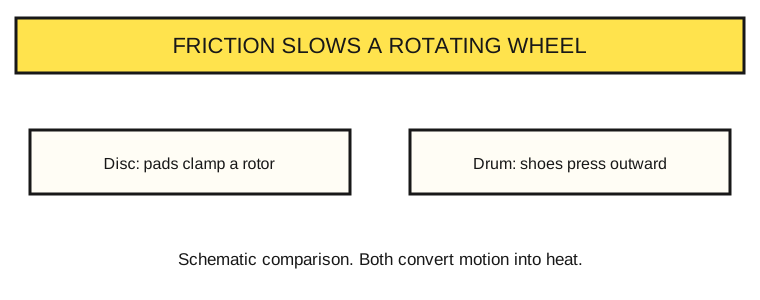
A disc brake clamps friction pads against a rotating disc. A drum brake pushes friction-lined shoes against the inside of a rotating drum. Both resist wheel rotation and convert motion into heat. The arrangement fitted to a car does not, by itself, establish its stopping distance or current brake condition.
Different shapes create contact with a rotating part
A disc, also called a rotor, turns with the wheel. The caliper holds the pads and applies clamping force. In a typical hydraulic system, brake-fluid pressure moves a piston in the caliper. Contact between the pads and disc resists rotation and produces heat.
A drum also rotates with the wheel. Its friction surfaces face inward. A typical hydraulic wheel cylinder pushes the shoes outward against those surfaces. Springs help withdraw the shoes when braking ends. The components differ, although the basic energy change remains motion into heat.
Sources: Akebono Brake Industry ↗ · Akebono Brake Industry ↗ · Brembo Parts ↗
The fitted arrangement is part of a complete design
A car can use discs on one axle and drums on another. A parking brake can also use a separate arrangement from the main service brake. Do not assume every visible disc tells you how the parking brake operates. Identify the equipment on the exact vehicle.
Pads, shoes, discs, and drums can wear. Hydraulic components, controls, tires, and the road surface also affect braking. Comparing only the names of the friction components leaves out these other parts of the system. A larger or more expensive-looking brake is not a condition report.
Sources: Akebono Brake Industry ↗ · Brembo Parts ↗ · National Highway Traffic Safety Administration ↗ · Brembo ↗
Common misunderstandings
Drum brakes do not automatically make a car unsafe or outdated. Their suitability depends on the vehicle’s complete engineering and their condition. Equally, four disc brakes do not prove that servicing has been done correctly.
Electric cars still need friction brakes even when regeneration handles some slowing. Less frequent use does not remove inspection needs. The buying question is whether the whole braking system performs correctly and meets its maintenance requirements, rather than whether its parts match a preferred visual style.
Sources: Akebono Brake Industry ↗ · U.S. Department of Energy ↗ · Tesla ↗
Sources & review
Reviewed . Original educational explanation, checked against the sources below. This is general guidance; consult the documents for the exact vehicle, year, configuration, and market.
- Disc BrakesAkebono Brake Industry · Disc brake construction; How disc brakes work; Main components. Broad performance comparisons are not adopted. · Accessed 2026-10-23.
- Drum BrakesAkebono Brake Industry · Structure of drum brakes; How drum brakes work; Main components. Broad performance comparisons are not adopted. · Accessed 2026-10-23.
- What causes brake discs to overheat and how to avoid itBrembo Parts · Friction, heat, and brake performance · Accessed 2026-10-22.
- Minimum brake disc thicknessBrembo Parts · How do you measure the minimum brake disc thickness? Wear and minimum specification; no universal threshold adopted · Accessed 2026-10-23.
- Tire Safety Ratings and Awareness · TireWiseNational Highway Traffic Safety Administration · Tire Maintenance; Tire Pressure; Aging · Accessed 2026-10-22.
- Brake Fluid solutions for carBrembo · FAQs: Are brake fluids interchangeable? What is vapour lock? · Accessed 2026-10-22.
- Buying a Used Car From a DealerFederal Trade Commission · Do Some Homework; Get an Independent Inspection Before You Buy; The Buyers Guide · Accessed 2026-10-22.
- Instrument Cluster — Warning Lamps and IndicatorsFord Motor Company · online owner manual · Warning Lamps and Indicators; Engine Oil Warning Lamp; Malfunction Indicator Lamp; Scheduled Maintenance Indicator Lamp · Accessed 2026-10-22.
- Maintenance and Safety of Electric VehiclesU.S. Department of Energy · Alternative Fuels Data Center · Maintenance Comparison and Battery Maintenance · Accessed 2026-10-22.
- Braking and Stopping — Model S Owner’s ManualTesla · Regenerative Braking: cold or full battery limits; friction-brake maintenance. Model-specific controls not generalized. · Accessed 2026-10-22.