The short answer
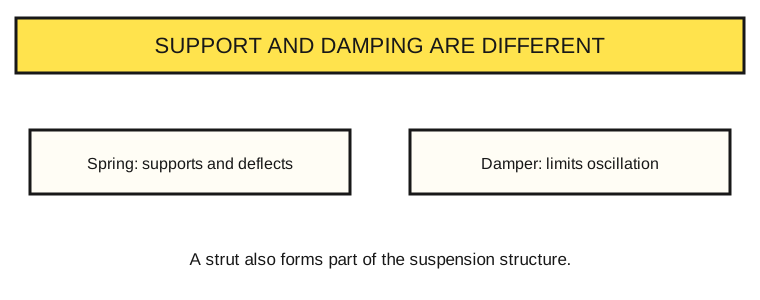
A spring supports load and allows suspension movement. A damper restrains repeated bouncing by resisting that movement. A strut incorporates damping while also serving a structural role in the suspension. These terms overlap in everyday conversation, but they do not name interchangeable parts.
A spring allows movement but can keep oscillating
A road bump makes the wheel move relative to the body. The spring deflects and stores energy, then releases it as it moves back. Without enough damping, this motion can repeat. Support and motion control therefore require different functions.
A hydraulic damper forces fluid through controlled passages as it moves. That resistance reduces repeated oscillation and turns some movement energy into heat. The term shock absorber commonly means this damper, even though the spring does much of the initial deflection over a bump. Both contribute to tire contact and vehicle control.
Sources: KYB Americas ↗ · Monroe / DRiV ↗
A strut also has a structural role
A strut is more than a damper placed near a spring. It forms part of the suspension structure. A common strut assembly includes the damping unit, a coil spring, and mounting parts, but the parts supplied in a repair kit depend on the product and vehicle.
Different cars use different suspension layouts, sometimes with struts at one axle and separate dampers at another. Air springs and electronically controlled damping introduce further variations. A smooth ride during one short journey cannot identify every component or establish its remaining service life.
Sources: Monroe / DRiV ↗ · KYB Americas ↗
Common misunderstandings
Firm suspension does not automatically mean worn suspension. A sporty specification may intentionally feel firmer. Equally, a soft ride is not proof that wheel control remains adequate. Condition and the intended design need separate assessment.
A new damper does not replace a damaged spring or every worn mounting part. ‘New struts’ also needs clarification about the assembly and work included. Do not use one universal replacement distance or a simple body-bounce demonstration as proof that every suspension component has passed inspection.
Sources: Monroe / DRiV ↗ · Federal Trade Commission ↗ · Ford UK ↗
Sources & review
Reviewed . Original educational explanation, checked against the sources below. This is general guidance; consult the documents for the exact vehicle, year, configuration, and market.
- How shocks workKYB Americas · Here are the basics; shock absorbers and hydraulic damping · Accessed 2026-10-22.
- Shocks vs. struts: What’s the Difference?Monroe / DRiV · Structural role of struts; springs versus damping. Marketing comparisons and generic replacement intervals excluded. · Accessed 2026-10-23.
- Buying a Used Car From a DealerFederal Trade Commission · Do Some Homework; Get an Independent Inspection Before You Buy; The Buyers Guide · Accessed 2026-10-22.
- What You Need to Know About Tire AlignmentBridgestone Americas · What is tire alignment?; Camber, toe and caster; Tire balancing. Generic intervals and single-cause symptom diagnoses are not adopted. · Accessed 2026-10-22.
- Service Intervals and Oil Change IntervalsFord UK · When should I get my car serviced?; variable oil service intervals · Accessed 2026-10-22.