The short answer
Required means the engine needs the higher octane to avoid knock and damage, and the manual states a minimum. Recommended means the engine runs safely on regular, and premium can add a small amount of power or economy under hard use. Regular means premium adds nothing. The fuel-door label and the manual settle it for your car.
Octane is knock resistance, not energy
The Federal Trade Commission’s consumer guide defines octane ratings as a measure of a gasoline’s ability to resist engine knock. Knock is a rattling or pinging sound from premature ignition of the compressed mixture in a cylinder. Most U.S. stations offer three grades: regular at about 87, mid-grade at about 89, and premium at about 92 or 93. The rating must appear on a yellow sticker on the pump.
A higher octane number does not mean more energy in the fuel. It means the fuel tolerates more compression and heat before it ignites on its own. An engine with a high compression ratio, or a turbocharger that packs in more air, needs that tolerance. An engine designed for regular does not.
The FTC notes that the names premium and regular are not consistent across states. One state can require 92 for premium, and another can allow 90. Read the number on the sticker, not the word on the button.
Sources: Federal Trade Commission ↗ · U.S. Energy Information Administration ↗
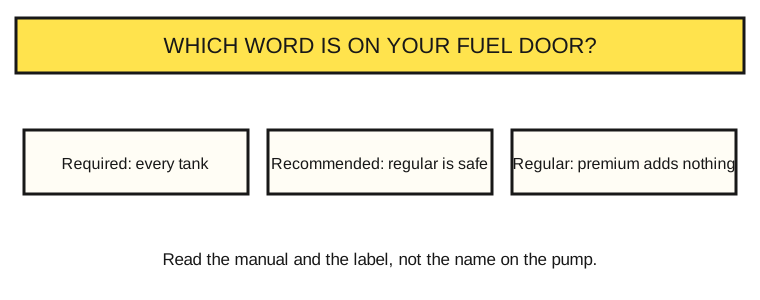
Three labels, three meanings
Regular. Kia’s 2024 Forte manual states that the car is designed for unleaded fuel of RON 91 / AKI 87 or higher. That is regular at a U.S. pump. The FTC says that a higher octane than the manual recommends offers no benefit: not more performance, not more speed, not better mileage, not a cleaner engine.
Premium recommended. AAA tested vehicles that recommend but do not require premium. It found no benefit in typical city or highway driving. Under extreme scenarios such as towing, hauling cargo, and aggressive acceleration, it measured modest gains in fuel economy and performance. A modern engine control detects knock and adjusts ignition timing. With regular it protects the engine, and with premium it can use its full calibration under load.
Premium required. AAA’s guidance is direct: a vehicle that requires premium must get premium in every tank. The manual states a minimum octane because the engine’s compression or boost can produce damaging knock below it. This is a design requirement, not a preference.
Sources: Kia, 2024 Forte (BDm) online owner manual, U.S. edition ↗ · Federal Trade Commission ↗ · AAA ↗
What premium costs over a year
In 2017, AAA reported a price gap between premium and regular of 25 percent or more per gallon, up from a steady 10 percent. The Energy Information Administration publishes the regular-gasoline average every week. For the week of November 2, 2026, the national average was about $4.15 per gallon.
Combine the two. A 25 percent gap on $4.15 is about $1 per gallon. A car that travels 12,000 miles a year at 30 miles per gallon uses 400 gallons. Premium then costs about $400 more per year. For a car that requires premium, that is part of the cost of the car. For a car that only recommends it, AAA’s testing says the return is small unless the car works hard.
Sources: AAA ↗ · U.S. Energy Information Administration ↗
Common misunderstandings
Premium does not clean an engine better than regular. The FTC states that all octane grades of all brands must contain detergent additives under EPA rules. A higher octane does not add cleaning power.
A tank of premium in a regular car is not a treat for the engine. The engine control does not change its calibration because the fuel can tolerate more. The FTC’s summary is that it will not make the car perform better, go faster, get better mileage, or run cleaner.
Mid-grade is not a safe compromise for a car that requires 91 or 93. A requirement is a minimum. The number below it is below the minimum.
Sources: Federal Trade Commission ↗ · AAA ↗
Questions people ask
I put regular in a premium-required car by mistake. What now? Read the manual for the exact car. Drive gently until the tank is mostly empty, then refill with the required grade. The FTC says that occasional light knock is not harmful. Persistent knock after one or two correct fill-ups needs a repair, not more octane.
My regular car knocks on 87. Is premium the fix? The FTC suggests the next grade up as a test. If the knock continues after one or two fill-ups, the engine needs attention, and the fix is a repair rather than a permanent fuel upgrade.
Does a turbo always need premium? No. Kia’s turbocharged Forte specifies 87. The manufacturer calibrates each engine for a fuel grade and prints it in the manual.
Do tuned engines need premium? A tune that raises boost or advances timing usually specifies a higher octane, because the tuner calibrated for it. That is a modification requirement, not a manufacturer one.
Sources: Federal Trade Commission ↗ · Kia, 2024 Forte (BDm) online owner manual, U.S. edition ↗ · AAA ↗
Fifi takes regular, and that is the end of it
Fifi’s manual says regular, 87 octane, so that is what she gets. Four years, 70,000 miles, no knock, no drama. A turbo badge did not change the fuel requirement.
The modders. In the Forte GT owners group I see people who run premium. They are the ones who have tuned the engine for more power, and the tune calls for the higher octane. That is a modification choice, not something the stock car needs. I did not bother with mods, so I did not bother with premium.
The habit. Read the fuel door once, and stop thinking about it. The car does not know the pump had a button that cost more.
Sources & review
Reviewed . Original educational explanation, checked against the sources below. This is general guidance; consult the documents for the exact vehicle, year, configuration, and market.
- The Low-Down on High Octane GasolineFederal Trade Commission · Facts for Consumers, October 2003 (GovInfo copy) · Octane ratings measure knock resistance; typical grades 87, 89 and 92 or 93; regular recommended for most cars; higher octane than the manual recommends offers no benefit; all grades carry detergents; premium and regular names vary by state; light knock versus persistent knock. · Accessed 2026-11-05.
- Gasoline explained: Octane in depthU.S. Energy Information Administration · What are octane ratings?; pump-label calculation (R+M)/2. Federal educational facts only. · Accessed 2026-10-22.
- Fuel requirements — UnleadedKia, 2024 Forte (BDm) online owner manual, U.S. edition · Designed for unleaded fuel of RON 91 / AKI 87 or higher; never use leaded fuel; no unspecified fuel-system additives. A model-specific example of a regular-fuel requirement. · Accessed 2026-11-05.
- Don’t Be Fueled: Premium Not Always Worth the PriceAAA · newsroom, December 12, 2017 · Testing of vehicles that recommend but do not require premium: modest gains only under extreme scenarios such as towing, hauling cargo and aggressive acceleration; no benefit in typical city or highway driving; the premium price gap; drivers of vehicles that require premium should always use it. · Accessed 2026-11-05.
- Gasoline and Diesel Fuel UpdateU.S. Energy Information Administration · Weekly U.S. and regional average retail prices for regular gasoline and diesel; the national regular-gasoline average of about $4.15 per gallon for the week of November 2, 2026, used as an illustrative figure. · Accessed 2026-11-05.
- Buying a Used Car From a DealerFederal Trade Commission · Do Some Homework; Get an Independent Inspection Before You Buy; The Buyers Guide · Accessed 2026-10-22.