The short answer
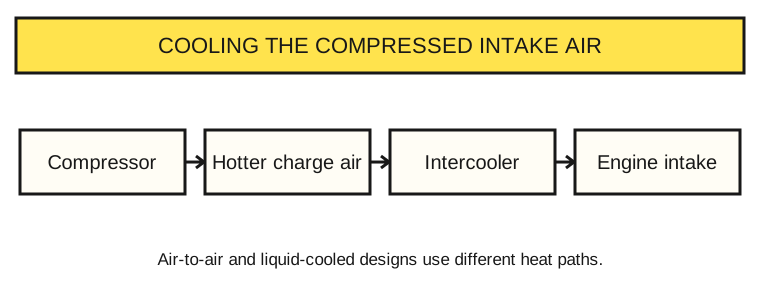
An intercooler removes heat from compressed intake air before that air reaches the engine. Compressing air heats it. Cooling the charge can increase its density for a given pressure and help manage engine temperature conditions. The intercooler’s layout and cooling method depend on the engine design.
Compression raises intake-air temperature
A turbocharger uses exhaust energy to drive a compressor on the intake side. The compressor raises the air pressure supplied toward the cylinders. Compression also increases the air temperature. Raising pressure and adding heat are related effects, but they do not have identical consequences for the air charge.
An intercooler provides a path for some of this heat to leave the intake air. Cooler air is denser at the same pressure, so a given intake volume can contain more air mass. The engine’s controls still manage fuel, boost, and other conditions. Adding a cooler does not independently set the engine’s final output.
Sources: Cummins ↗ · DENSO Europe ↗
There are different paths for the removed heat
An air-to-air intercooler transfers heat from the compressed air toward outside airflow through its heat-exchanger surfaces. A liquid-cooled charge-air cooler transfers heat into a cooling liquid, which needs its own way to release heat. Components and packaging differ between vehicles.
Do not confuse an intercooler with the engine coolant radiator or the air-conditioning condenser. They can look similar because all transfer heat, but their circuits serve different jobs. Some sit together at the front of a car, while other layouts place charge-air cooling closer to the engine.
Sources: DENSO Europe ↗ · DENSO Europe ↗ · DENSO Europe ↗
Common misunderstandings
The intercooler does not cool exhaust gases in the ordinary intake-charge arrangement described here. Exhaust drives the turbocharger’s turbine; compressed fresh intake air passes through the charge-air cooler. Keeping those paths distinct makes the mechanism easier to follow.
More boost is not an automatic improvement for a used car buyer. Temperature control, fueling, hardware limits, and calibration all matter. Compare the specified vehicle and its condition rather than treating an altered boost reading or an aftermarket part as evidence of better reliability or lower ownership cost.
Sources: Cummins ↗ · DENSO Europe ↗ · U.S. Department of Energy ↗
Sources & review
Reviewed . Original educational explanation, checked against the sources below. This is general guidance; consult the documents for the exact vehicle, year, configuration, and market.
- How a turbocharger worksCummins · Turbine and compressor operation · Accessed 2026-10-22.
- IntercoolersDENSO Europe · How intercoolers work; Intercoolers types. Air-to-air and liquid-cooled variants; layout not generalized. · Accessed 2026-10-23.
- Cooling RadiatorsDENSO Europe · How radiators work; Fault finding · Accessed 2026-10-22.
- DENSO: the real A/C SpecialistsDENSO Europe · How do air-conditioning systems work? Generic service intervals are not adopted. · Accessed 2026-10-22.
- Buying a Used Car From a DealerFederal Trade Commission · Do Some Homework; Get an Independent Inspection Before You Buy; The Buyers Guide · Accessed 2026-10-22.
- Frequently Asked Questions About On-Board DiagnosticsU.S. Environmental Protection Agency · EPA 420-F-97-003 · What Is OBD And How Does It Work?; How Does OBD Inform Drivers Of Problems?; Why Does The Dashboard Light Blink Or Flash? · Accessed 2026-10-22.
- Vehicle Cost CalculatorU.S. Department of Energy · Alternative Fuels Data Center · Vehicle comparison inputs; cost assumptions and total ownership cost · Accessed 2026-10-22.