The short answer
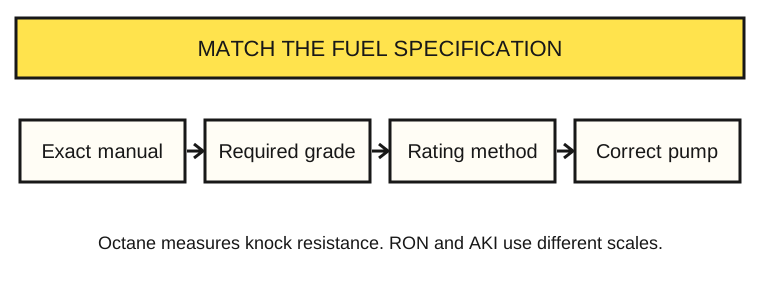
Octane rating measures gasoline’s resistance to engine knock under standardized tests. It does not directly measure how much energy the fuel contains. Use the fuel grade and rating method specified for the car. A higher pump number is useful only in the context of the engine’s requirements and the scale used.
Knock is an unwanted combustion behavior
In normal spark-ignition operation, a timed spark starts combustion. Knock involves part of the remaining mixture igniting in an uncontrolled way under the conditions inside the cylinder. The resulting pressure disturbances can damage an engine. Fuel selection forms part of the engine’s strategy for avoiding this behavior.
Higher-octane gasoline resists knock better under its rating tests. That does not mean it is a universal power upgrade or a bottle of extra energy. Engines differ in compression, boost, controls, and the fuel they require to operate as intended. The correct grade comes from the vehicle’s instructions.
Sources: U.S. Energy Information Administration ↗ · U.S. Department of Energy ↗ · Toyota Motor Sales ↗
The same fuel can carry different numbers
Research Octane Number is abbreviated RON. Motor Octane Number uses a different test. Anti-Knock Index, abbreviated AKI, averages these two test results. A North American pump may label that average as (R+M)/2. Many other markets display RON instead.
A number without its scale can therefore mislead. Do not compare a RON requirement directly with an AKI pump number, or rely on one fixed conversion for every fuel. Check the wording in the manual and on the pump. Imported cars particularly need documentation that matches the intended market and engine.
Sources: Petroleum Equipment Institute ↗ · U.S. Energy Information Administration ↗
Common misunderstandings
Premium does not mean every car needs it. Equally, an engine that requires a higher grade should not be treated as if any gasoline will do. The manufacturer’s wording resolves the question for that engine.
Octane rating does not identify diesel compatibility, ethanol approval, or every fuel-quality requirement. Those are separate specifications. Read all applicable instructions, including any restrictions on fuel blends. Never choose a fuel solely because its nozzle fits or its label uses a familiar marketing name.
Sources: U.S. Energy Information Administration ↗ · U.S. Department of Energy ↗ · U.S. Department of Energy ↗ · Toyota Motor Sales ↗
Sources & review
Reviewed . Original educational explanation, checked against the sources below. This is general guidance; consult the documents for the exact vehicle, year, configuration, and market.
- Gasoline explained: Octane in depthU.S. Energy Information Administration · What are octane ratings?; pump-label calculation (R+M)/2. Federal educational facts only. · Accessed 2026-10-22.
- Internal Combustion Engine BasicsU.S. Department of Energy · How Does an Internal Combustion Engine Work? · Accessed 2026-10-22.
- Basic Car Maintenance Tips & Services ChecklistToyota Motor Sales · 10. Inspect Your Belts and Hoses; 13. Replace Your Engine Air Filter; 14. Check Your Spark Plugs. Generic intervals and unqualified fuel-economy claims are not adopted. · Accessed 2026-10-22.
- Octane NumberPetroleum Equipment Institute · Measurement methods: Research Octane Number and Anti-Knock Index. No universal conversion assumed. · Accessed 2026-10-22.
- Vehicle Cost CalculatorU.S. Department of Energy · Alternative Fuels Data Center · Vehicle comparison inputs; cost assumptions and total ownership cost · Accessed 2026-10-22.
- Frequently Asked Questions About On-Board DiagnosticsU.S. Environmental Protection Agency · EPA 420-F-97-003 · What Is OBD And How Does It Work?; How Does OBD Inform Drivers Of Problems?; Why Does The Dashboard Light Blink Or Flash? · Accessed 2026-10-22.
- How Do Gasoline Cars Work?U.S. Department of Energy · Alternative Fuels Data Center · Introduction and Key Components of a Gasoline Car · Accessed 2026-10-22.
- How Do Diesel Vehicles Work?U.S. Department of Energy · Alternative Fuels Data Center · Introduction and Key Components of a Light-Duty Diesel Vehicle · Accessed 2026-10-22.