The short answer
An engine’s geometric compression ratio compares the cylinder volume above the piston at its lowest position with that volume at its highest position. It is a ratio, not a volume or a pressure reading. Engine displacement describes swept volume instead. These numbers answer different questions about the engine.
The piston changes the available space
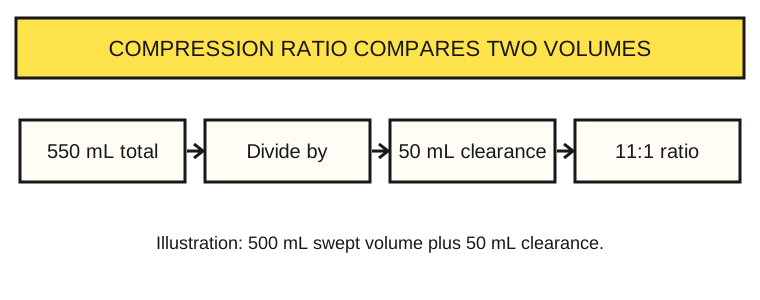
As a piston rises during compression, it reduces the space above it. Some space remains when it reaches the top. That remaining space is the clearance volume. The cylinder’s largest volume includes both this clearance and the volume swept through by the piston.
For an illustrative cylinder, let swept volume be 500 milliliters and clearance volume be 50 milliliters. The largest volume is 550 milliliters. Divide 550 by 50 to obtain 11. The geometric compression ratio is therefore 11:1. The swept volume of this cylinder remains 500 milliliters; the ratio does not change its unit into liters.
Sources: NASA Glenn Research Center ↗ · NASA Glenn Research Center ↗
Compression affects the conditions before combustion
Compressing gas generally raises its pressure and temperature. An idealized thermodynamic model helps explain this effect, but real engines also exchange heat and have losses. Valve operation and the amount of air entering the cylinder influence actual operating conditions.
Compression ratio can affect thermal efficiency, meaning the share of fuel energy turned into useful work. In a gasoline engine, avoiding unwanted knock constrains the design as well. Fuel choice, combustion control, boost, and other engineering decisions work together. A single ratio cannot predict the fuel consumption or power of the finished car.
Sources: NASA Glenn Research Center ↗ · Mazda Motor Corporation ↗ · U.S. Energy Information Administration ↗ · U.S. Department of Energy ↗
Common misunderstandings
A 2.0-liter engine is not an engine with a 2:1 compression ratio. The first number states displacement; the second would describe a volume relationship. Neither one states the number of cylinders by itself.
A high compression ratio is not automatically good or bad. It belongs to a complete design with a specified fuel and control strategy. Compare complete vehicles for your intended use. A specification can explain a mechanism while still leaving important questions about condition, running cost, and service history unanswered.
Sources: NASA Glenn Research Center ↗ · Mazda Motor Corporation ↗ · U.S. Department of Energy ↗
Sources & review
Reviewed . Original educational explanation, checked against the sources below. This is general guidance; consult the documents for the exact vehicle, year, configuration, and market.
- Isentropic CompressionNASA Glenn Research Center · Compression Ratio: volume ratio. Ideal thermodynamic assumptions not presented as an exact real-engine model. Government educational facts only. · Accessed 2026-10-22.
- Bore and StrokeNASA Glenn Research Center · Bore, stroke, and total displacement definitions (final two technical paragraphs) · Accessed 2026-10-22.
- Where Engine Dreams Meet Possibilities: The SKYACTIV-Z Challenge and Mazda’s Internal Combustion-Focused Electrification StrategyMazda Motor Corporation · Compression ratio, efficiency and knock discussion; technology claims not generalized. · Accessed 2026-10-22.
- Gasoline explained: Octane in depthU.S. Energy Information Administration · What are octane ratings?; pump-label calculation (R+M)/2. Federal educational facts only. · Accessed 2026-10-22.
- Internal Combustion Engine BasicsU.S. Department of Energy · How Does an Internal Combustion Engine Work? · Accessed 2026-10-22.
- Buying a Used Car From a DealerFederal Trade Commission · Do Some Homework; Get an Independent Inspection Before You Buy; The Buyers Guide · Accessed 2026-10-22.
- Compression Tester User’s Manual — 5606OTC / Bosch Automotive Service Solutions · Page 1, Compression Test: pressure readings compared with vehicle manufacturer specifications. No repair diagnosis generalized from one reading. · Accessed 2026-10-22.
- Vehicle Cost CalculatorU.S. Department of Energy · Alternative Fuels Data Center · Vehicle comparison inputs; cost assumptions and total ownership cost · Accessed 2026-10-22.