The short answer
Engine displacement is the combined volume swept by all the pistons in one full stroke. A 2.0-liter engine sweeps about 2,000 cubic centimeters in total.
Measure the space the pistons sweep
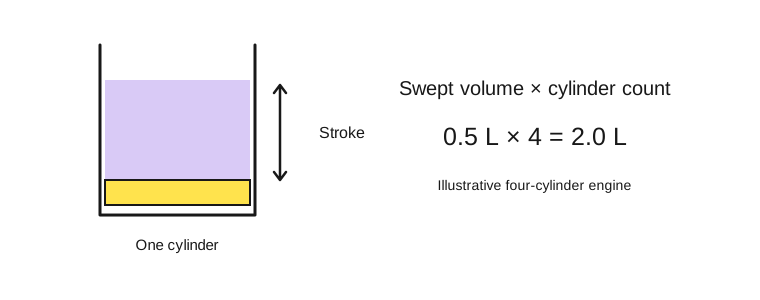
The bore is the inside diameter of a cylinder. The stroke is the distance the piston travels from its highest position to its lowest. A wider bore or a longer stroke increases the volume that piston sweeps.
Add the swept volume of every cylinder to find total displacement. In an illustrative 2.0-liter four-cylinder engine with equal cylinders, each cylinder sweeps 0.5 liters, or 500 cubic centimeters. The figure is rounded in many model names.
Sources: NASA Glenn Research Center ↗
Volume is not power
Displacement tells you about geometry. It does not tell you exactly how much air the engine uses in real operation, how efficiently it burns fuel, or how quickly it turns. A turbocharger can push extra air into a smaller engine, allowing it to burn more fuel when power is needed.
Two engines marked 2.0 liters can therefore have very different power ratings and fuel use. Even an engine badge may be a model label rather than a precise statement of displacement. Check the manufacturer’s technical specification.
Sources: U.S. Department of Energy / U.S. Environmental Protection Agency ↗ · NASA Glenn Research Center ↗
Common misunderstandings
A 2.0-liter engine does not use two liters of fuel each time it fires. Displacement measures swept space, not fuel consumption. It is also unrelated to the fuel tank’s capacity.
Cubic centimeters and liters are different units for the same kind of volume: 1,000 cubic centimeters equal one liter. Cylinder count alone cannot tell you the displacement.
Sources: NASA Glenn Research Center ↗
Sources & review
Reviewed . Original educational explanation, checked against the sources below. This is general guidance; consult the documents for the exact vehicle, year, configuration, and market.
- Bore and StrokeNASA Glenn Research Center · Bore, stroke, and total displacement definitions (final two technical paragraphs) · Accessed 2026-10-22.
- Advanced Engine TechnologiesU.S. Department of Energy / U.S. Environmental Protection Agency · FuelEconomy.gov · Turbocharging with Engine Downsizing; Gasoline Direct Injection · Accessed 2026-10-22.