The short answer
Gasoline supplies fuel. The oxygen in air allows it to burn. Burning creates hot gas that expands and pushes the pistons.
Meet the four-stroke cycle
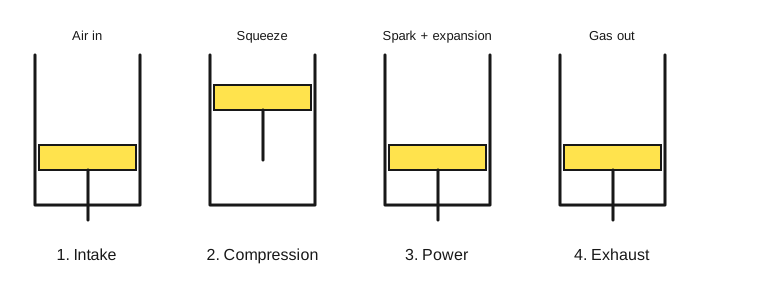
A stroke is one trip of the piston up or down its cylinder. Most car gasoline engines repeat four strokes. First, the intake stroke brings air into the cylinder. Next, compression squeezes the contents into a smaller space. A spark then starts combustion near the end of compression, and expanding gas pushes the piston down on the power stroke. Finally, the exhaust stroke pushes spent gas out.
Valves open and close the passages for intake air and exhaust gas. The crankshaft keeps turning as the pistons repeat this sequence. Several cylinders share the work in a typical car engine.
Sources: U.S. Department of Energy ↗
Why the mixture matters
The engine must meter fuel to match the air available. Modern gasoline engines use fuel injectors to deliver controlled amounts. Some inject into the passage before the cylinder. Direct-injection engines inject into the cylinder itself. The exact timing and mixture depend on the engine and operating conditions.
Diesel engines also need air and fuel, but they normally ignite injected fuel using the heat of highly compressed air. They do not use a spark plug to start each normal combustion event.
Sources: U.S. Department of Energy ↗ · U.S. Department of Energy / U.S. Environmental Protection Agency ↗ · U.S. Department of Energy ↗
Common misunderstandings
A gasoline engine does not run on fuel alone. It also needs a controlled supply of air. A turbocharger changes how much air can enter; it does not replace the fuel.
This four-stroke explanation describes the operating principle. Fuel injection, valve control, and combustion strategies vary by model and year.
Sources: U.S. Department of Energy / U.S. Environmental Protection Agency ↗ · U.S. Department of Energy ↗
Sources & review
Reviewed . Original educational explanation, checked against the sources below. This is general guidance; consult the documents for the exact vehicle, year, configuration, and market.
- Internal Combustion Engine BasicsU.S. Department of Energy · How Does an Internal Combustion Engine Work? · Accessed 2026-10-22.
- How Do Gasoline Cars Work?U.S. Department of Energy · Alternative Fuels Data Center · Introduction and Key Components of a Gasoline Car · Accessed 2026-10-22.
- Advanced Engine TechnologiesU.S. Department of Energy / U.S. Environmental Protection Agency · FuelEconomy.gov · Turbocharging with Engine Downsizing; Gasoline Direct Injection · Accessed 2026-10-22.
- How Do Diesel Vehicles Work?U.S. Department of Energy · Alternative Fuels Data Center · Introduction and Key Components of a Light-Duty Diesel Vehicle · Accessed 2026-10-22.