The short answer
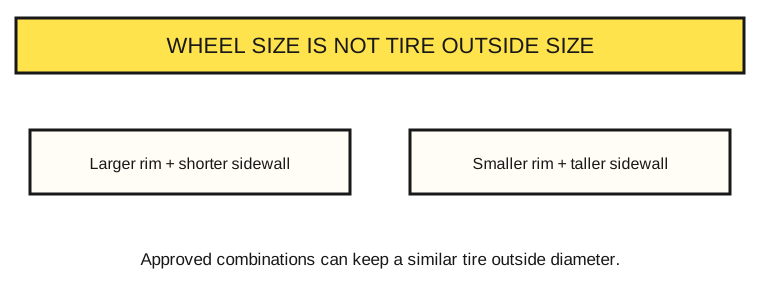
A wheel’s rim diameter is only one part of the tire-and-wheel combination. An approved larger rim may use a tire with a shorter sidewall to keep a similar outside diameter. Sidewall design can affect ride feel, but tire construction, pressure, suspension, and road conditions matter too. Bigger wheels are not automatically better for every buyer.
The sidewall occupies space outside the rim
A tire wraps around its wheel. Its sidewalls extend outward from the rim toward the tread. The complete tire’s outside diameter therefore includes more than the rim diameter. A wheel-size number alone cannot tell you the distance traveled in one wheel revolution.
In many approved alternative combinations, increasing rim diameter is accompanied by a lower-profile tire with a shorter sidewall. This can keep the outside tire diameter similar. It does not mean any larger wheel and tire combination is acceptable. Width, load rating, speed rating, clearances, and other fitment requirements still need to match the vehicle.
Sources: Michelin USA ↗ · National Highway Traffic Safety Administration ↗ · Michelin New Zealand ↗
Ride feel depends on the complete setup
A tire’s sidewall flexes as the wheel encounters the road. Taller sidewalls can contribute to cushioning, while a lower-profile setup may feel firmer. Michelin’s explanation describes this general relationship. Individual tire construction and the rest of the vehicle still influence the result.
Do not assume wheel diameter alone explains every vibration or harsh ride. Incorrect pressure, tire damage, mass imbalance, alignment, or suspension condition can require separate investigation. Compare like-for-like vehicles where practical, with suitable tire condition and the correct pressures, rather than attributing every difference to the wheel size.
Sources: Michelin New Zealand ↗ · Bridgestone Americas ↗ · National Highway Traffic Safety Administration ↗ · KYB Americas ↗
Common misunderstandings
A larger rim does not necessarily mean a larger tire outside diameter or a changed overall road-speed relationship. That depends on the complete tire size. Broad statements that larger wheels always change gearing omit this distinction.
A lower-profile tire is not proof of better braking, grip, or condition. Product design, surface, weather, pressure, and wear matter. Choose an approved setup that suits your driving needs, while keeping a professional condition assessment separate from preferences about appearance or steering feel.
Sources: Michelin USA ↗ · University of California San Diego ↗ · National Highway Traffic Safety Administration ↗ · Michelin New Zealand ↗
Sources & review
Reviewed . Original educational explanation, checked against the sources below. This is general guidance; consult the documents for the exact vehicle, year, configuration, and market.
- Do I need new tires? Performance upgradeMichelin USA · Plus sizing and manufacturer-approved alternative wheel diameters. No general tire upgrade recommendation adopted. · Accessed 2026-10-23.
- Tire Safety Ratings and Awareness · TireWiseNational Highway Traffic Safety Administration · Tire Maintenance; Tire Pressure; Aging · Accessed 2026-10-22.
- How does wheel size affect car performance?Michelin New Zealand · Ride comfort and lower-profile tires. Wheel diameter is not treated as tire outside diameter; broad gearing claim explicitly qualified. · Accessed 2026-10-23.
- What You Need to Know About Tire AlignmentBridgestone Americas · What is tire alignment?; Camber, toe and caster; Tire balancing. Generic intervals and single-cause symptom diagnoses are not adopted. · Accessed 2026-10-22.
- How shocks workKYB Americas · Here are the basics; shock absorbers and hydraulic damping · Accessed 2026-10-22.
- Buying a Used Car From a DealerFederal Trade Commission · Do Some Homework; Get an Independent Inspection Before You Buy; The Buyers Guide · Accessed 2026-10-22.
- Vehicle Cost CalculatorU.S. Department of Energy · Alternative Fuels Data Center · Vehicle comparison inputs; cost assumptions and total ownership cost · Accessed 2026-10-22.
- Gear RatiosUniversity of California San Diego · MAE 3 · Energy and Power Equations; Analysis of a Gear Pair; Summary. Mathematical facts only; no teaching artwork or exercise adapted. · Accessed 2026-10-22.