The short answer
Air conditioning transfers heat from cabin air to the outside using circulating refrigerant. A blower moves air through the ventilation system. Heating may use warm engine coolant, electric resistance, a heat pump, or a combination. The exact system matters, especially when comparing electric cars in cold weather.
Cooling means transferring heat
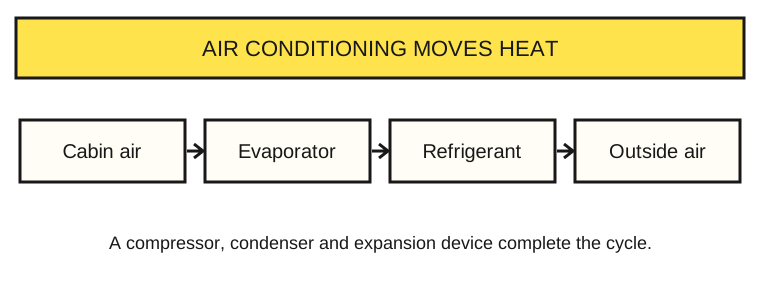
In a conventional air-conditioning cycle, refrigerant absorbs heat at the evaporator inside the ventilation system. A compressor raises refrigerant pressure. The condenser releases heat outside, and an expansion device lowers pressure before the next pass through the evaporator. The system circulates a working fluid rather than continually consuming a tank of cold air.
The blower performs a different job: it pushes air through heat exchangers and ducts toward the occupants. Air conditioning can also remove moisture from cabin air. Fan speed, air temperature, and humidity control therefore describe different aspects of comfort. Strong airflow does not prove that refrigeration works.
Sources: DENSO Europe ↗ · Toyota Canada ↗
Heating depends on the available heat source
Many combustion cars send warm engine coolant through a small cabin heat exchanger called a heater core. Air passing over it picks up heat. This arrangement depends on the engine producing heat and the system transferring it correctly.
A battery-electric car has no combustion engine supplying that heat. It may use electric resistance heating, a heat pump, or both. A heat pump moves heat and can use less electricity than resistance heating in many conditions. Its performance still depends on temperature and system design; the equipment badge cannot promise a fixed winter range.
Sources: DENSO Europe ↗ · U.S. Department of Energy ↗
Common misunderstandings
Engine coolant and air-conditioning refrigerant are different fluids. Their containers, circuits, specifications, and service procedures differ. A specialist should identify the cause of poor cooling and use the correct refrigerant and procedure for the car.
Automatic climate control describes how a system manages a chosen temperature. It does not by itself identify the heating technology or guarantee better efficiency. Good ventilation, refrigeration, and heating are separate checks, and the manufacturer’s maintenance information remains the starting point for servicing them.
Sources: DENSO Europe ↗ · Ford Motor Company ↗ · Ford UK ↗
Sources & review
Reviewed . Original educational explanation, checked against the sources below. This is general guidance; consult the documents for the exact vehicle, year, configuration, and market.
- DENSO: the real A/C SpecialistsDENSO Europe · How do air-conditioning systems work? Generic service intervals are not adopted. · Accessed 2026-10-22.
- Toyota Cabin Air Filters: What are They and Why are They Important?Toyota Canada · What is it?; Why is maintenance important? Locations and intervals remain model-specific. · Accessed 2026-10-22.
- Heater coresDENSO Europe · How heater cores work: coolant-to-cabin heat transfer · Accessed 2026-10-22.
- Winterizing Your Electric VehicleU.S. Department of Energy · Heat pump versus resistance heating; battery preconditioning and cabin warming. Federal education used as factual base; no illustrations reproduced. · Accessed 2026-10-22.
- Buying a Used Car From a DealerFederal Trade Commission · Do Some Homework; Get an Independent Inspection Before You Buy; The Buyers Guide · Accessed 2026-10-22.
- Maintenance — Engine Coolant CheckFord Motor Company · online owner manual · Engine Coolant Check: opening scalding warning and fluid-specification instruction. Only these general principles are used, not the model-specific filling procedure. · Accessed 2026-10-22.
- Service Intervals and Oil Change IntervalsFord UK · When should I get my car serviced?; variable oil service intervals · Accessed 2026-10-22.