The short answer
Corrosion can reduce metal thickness and strength. Its significance depends on the component, location, extent, and surrounding condition. A rusty surface and serious structural material loss are different findings. A buyer should have suspicious areas assessed professionally, including places hidden by trim, coverings, or a fresh coating.
The same-looking area can have a different significance
A component needs enough sound material to carry its intended loads. Corrosion can reduce that material. An area near a suspension mounting or another stressed connection can therefore require a different assessment from staining on a non-structural surface. Area alone is not a sufficient measure of seriousness.
The Great Britain inspection guidance explains how location, load-bearing function, reduced thickness, and the extent of nearby corrosion affect an assessment. Its statutory test boundaries apply in that jurisdiction. The engineering lesson is broader: identify what the affected part does before judging a rusty patch from its appearance.
Sources: Driver and Vehicle Standards Agency, Great Britain ↗
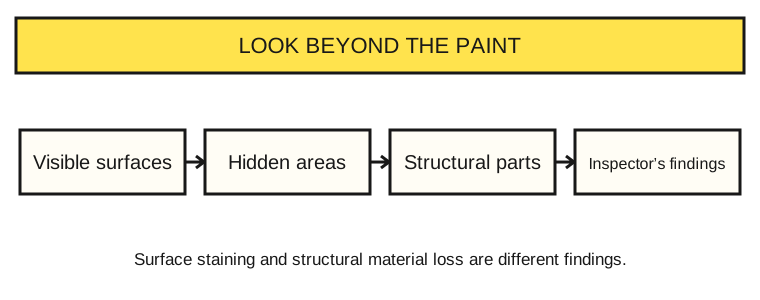
Visible surfaces do not show the complete condition
Corrosion can be concentrated in seams, cavities, or other areas that are difficult to see. Surrounding coatings may hide the extent of damage. A clean upper body therefore cannot establish the condition underneath. Inspection access and the method used should appear in the findings.
A repair also needs assessment of its suitability and the remaining structure around it. Paint or underbody coating does not, by itself, demonstrate that lost metal has been restored. Ask for repair records and an explanation of the method rather than accepting a fresh finish as evidence of structural soundness.
Sources: Driver and Vehicle Standards Agency, Great Britain ↗ · Federal Trade Commission ↗
Common misunderstandings
No universal patch size makes corrosion harmless or serious on every car. The component and location matter. A current inspection certificate also reflects its own scope and test date, rather than guaranteeing every hidden area for future ownership.
A history report cannot replace physical assessment of current corrosion. Equally, seeing surface rust does not prove that a whole car is unsafe. Ask for specific evidence, including any areas that could not be checked, and resolve important uncertainty before agreeing on the purchase.
Sources: Driver and Vehicle Standards Agency, Great Britain ↗ · Federal Trade Commission ↗
Sources & review
Reviewed . Original educational explanation, checked against the sources below. This is general guidance; consult the documents for the exact vehicle, year, configuration, and market.
- MOT inspection manual: Appendix A — Structural integrity and corrosionDriver and Vehicle Standards Agency, Great Britain · Sections 1-7 and 10-11: location, load-bearing parts, hidden corrosion and repairs. Great Britain test thresholds not generalized; no destructive inspection instructions reproduced. · Accessed 2026-10-23.
- Buying a Used Car From a DealerFederal Trade Commission · Do Some Homework; Get an Independent Inspection Before You Buy; The Buyers Guide · Accessed 2026-10-22.