The short answer
Flood exposure can affect mechanical, electrical, and interior components, with some problems appearing later. Cleaning can remove visible clues without establishing the condition of hidden systems. A buyer needs the vehicle’s records, the seller’s account, and a suitable independent inspection. No single smell, stain, or clean report proves the complete history.
Water exposure can leave delayed problems
A vehicle contains connections, controls, moving parts, and materials that can be affected by flooding. Restoring a clean appearance does not test each of those components. NHTSA warns that flood-related damage can create problems that appear after the original exposure.
The depth, duration, type of water, affected systems, and repair work all matter. A general label cannot establish the condition of a particular car. Equally, a running engine or functioning display during one demonstration cannot prove that every affected connection and component will remain reliable.
Sources: National Highway Traffic Safety Administration ↗ · Nevada Department of Motor Vehicles ↗
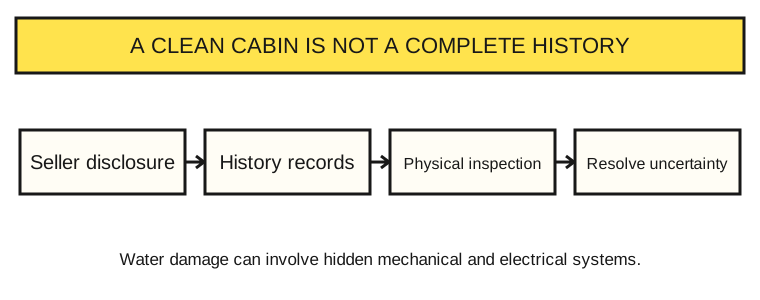
Clues and records answer different parts of the question
NHTSA and Nevada’s vehicle authority describe clues such as musty odors, heavy deodorizer, mud, waterlines, and unusual dirt or corrosion in hidden areas. These are reasons to investigate. They are not a checklist that lets a beginner certify a car as flood-free.
Title and history checks can reveal reported damage, but reporting is not complete or instant in every case. Check coverage and vehicle identity. A clean result leaves out unreported events. Title descriptions and branding procedures also depend on the market, so do not apply one state’s terminology or rules everywhere.
Sources: National Highway Traffic Safety Administration ↗ · Nevada Department of Motor Vehicles ↗
Common misunderstandings
An odor is not proof of flooding, and no odor is not proof of no flooding. New carpet or upholstery also needs context. A sound decision combines evidence rather than treating one clue as a verdict.
A low asking price does not define the cost or uncertainty of hidden damage. A seller’s recent cleaning invoice is not a mechanical or electrical assessment. Keep unresolved findings visible in the decision, and do not interpret an incomplete history report or a limited inspection as a guarantee about the whole vehicle.
Sources: National Highway Traffic Safety Administration ↗ · Nevada Department of Motor Vehicles ↗ · Federal Trade Commission ↗
Sources & review
Reviewed . Original educational explanation, checked against the sources below. This is general guidance; consult the documents for the exact vehicle, year, configuration, and market.
- Hurricane- and Flood-Damaged VehiclesNational Highway Traffic Safety Administration · Buyers Beware; How do I determine if a vehicle is flood-damaged? Delayed faults, history and physical signs. Federal education used as factual base. · Accessed 2026-10-23.
- Flood-Damaged VehiclesNevada Department of Motor Vehicles · Vehicle History Checks; Tips to Spot Flood Damage. Incomplete records and professional inspection; Nevada title procedures not generalized. · Accessed 2026-10-23.
- Buying a Used Car From a DealerFederal Trade Commission · Do Some Homework; Get an Independent Inspection Before You Buy; The Buyers Guide · Accessed 2026-10-22.
- Electric and Hybrid VehiclesNational Highway Traffic Safety Administration · Battery Lifespan and Types; Batteries and Temperature. Thermal management energy use; no lifespan prediction adopted. · Accessed 2026-10-22.