The short answer
A safety rating summarizes performance in a defined assessment program. It is evidence about specified tests and equipment, not a prediction of every crash. Read the detailed results and comparison rules behind the headline score.
First identify the assessment program
The U.S. National Highway Traffic Safety Administration, or NHTSA, conducts frontal, side, and rollover assessments in its five-star program. Other organizations use their own procedures. Euro NCAP, the European New Car Assessment Programme, also assesses vehicle safety, using its own test framework.
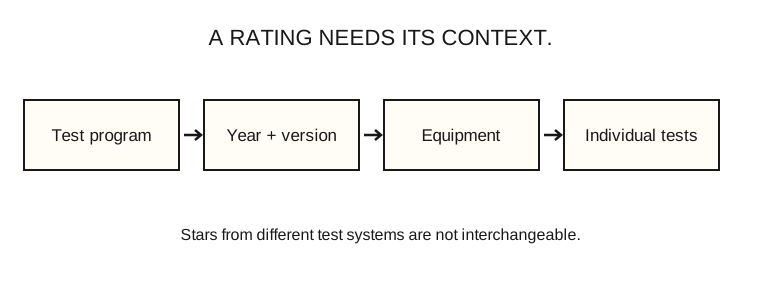
Do not treat a star as a universal unit of safety. Ratings from different programs can consider different situations and combine results in different ways. Crash protection concerns reducing injury during a collision. Crash avoidance concerns preventing a collision or reducing its severity. A program may assess both.
Sources: National Highway Traffic Safety Administration ↗ · Euro NCAP ↗
Year and equipment change the meaning
Assessment methods evolve. A score awarded under an earlier set of procedures may not be directly comparable with a score awarded under a newer set. Check the test year and the program’s own explanation of which comparisons are meaningful.
Read the equipment notes as well. Euro NCAP describes cases with two ratings: one for standard equipment and another for a specified optional safety package. The higher result does not establish that every used example has the optional equipment. Match the tested configuration with the car you can actually buy.
Sources: Euro NCAP ↗
Common misunderstandings
An overall result does not mean every individual assessment received the same result. The detailed report helps show where strengths and limitations lie.
A strong rating does not eliminate the need for seat belts, suitable tires, and attentive driving. It also does not promise the outcome of a collision with a different vehicle, speed, angle, or obstacle from those assessed. Use ratings as one defined source of evidence, alongside the actual car’s condition and equipment.
Sources: National Highway Traffic Safety Administration ↗ · Euro NCAP ↗
Sources & review
Reviewed . Original educational explanation, checked against the sources below. This is general guidance; consult the documents for the exact vehicle, year, configuration, and market.
- Car Safety RatingsNational Highway Traffic Safety Administration · Frontal, side and rollover tests; Frequently Asked Questions on comparisons and model years · Accessed 2026-10-22.
- The stars explainedEuro NCAP · European New Car Assessment Programme · Stages of safety; What are dual ratings?; Why the test year matters · Accessed 2026-10-22.
- Buying a Used Car From a DealerFederal Trade Commission · Do Some Homework; Get an Independent Inspection Before You Buy; The Buyers Guide · Accessed 2026-10-22.