The short answer
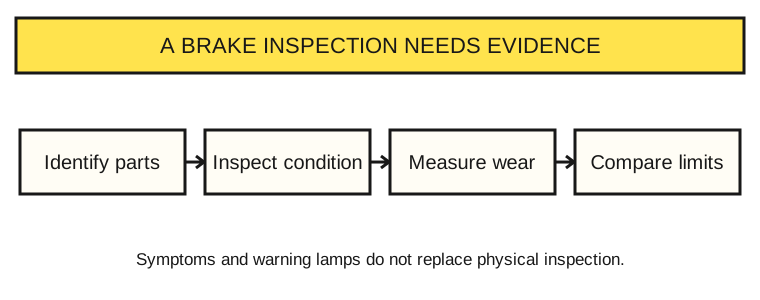
A useful brake inspection identifies the fitted system, checks its condition, and compares measured wear with the correct limits. It also considers fluid, leaks, operation, and warnings where included in the agreed scope. A test drive or a dashboard wear message cannot replace all of those checks.
Friction components lose material with use
Brake pads wear as they work against a disc. The disc can wear too. A disc that looks shiny through the wheel is therefore not necessarily within its thickness limit. A qualified technician uses appropriate measurements and the specification for the installed component.
The condition of the surfaces matters alongside thickness. A measurement at one easy-to-reach place cannot describe every possible crack, uneven area, or other defect. Ask which parts were accessible and how the inspector assessed them. Drum brakes need checks appropriate to their own construction rather than a disc measurement applied to a different component.
Sources: Brembo Parts ↗ · Akebono Brake Industry ↗
A warning system answers a limited question
Some vehicles monitor particular brake wear conditions. That does not mean every pad and every other component is continuously measured. Read the exact manual to learn what its message means and what response it requires. No warning is not a certificate that all brakes are healthy.
Brake fluid has a separate role: it transmits hydraulic pressure. Its specification, condition, and scheduled replacement belong to a different set of checks from friction thickness. An inspection should make clear whether it assessed fluid, visible hydraulic components, and stored faults, or only the friction parts.
Sources: Ford Motor Company ↗ · Brembo ↗ · Federal Trade Commission ↗
Common misunderstandings
There is no single replacement distance for every brake pad. Use, conditions, vehicle design, and the actual wear all matter. A seller’s claim that pads ‘usually last longer’ does not override a measured limit.
A car that stops once during a short drive can still have defects. Conversely, a noise alone does not prove which part has failed. Report symptoms accurately and seek diagnosis. Follow the manual’s immediate instructions for brake warnings, and do not continue a buying demonstration when safe operation is uncertain.
Sources: Brembo Parts ↗ · Federal Trade Commission ↗ · Ford Motor Company ↗
Sources & review
Reviewed . Original educational explanation, checked against the sources below. This is general guidance; consult the documents for the exact vehicle, year, configuration, and market.
- Minimum brake disc thicknessBrembo Parts · How do you measure the minimum brake disc thickness? Wear and minimum specification; no universal threshold adopted · Accessed 2026-10-23.
- Drum BrakesAkebono Brake Industry · Structure of drum brakes; How drum brakes work; Main components. Broad performance comparisons are not adopted. · Accessed 2026-10-23.
- Instrument Cluster — Warning Lamps and IndicatorsFord Motor Company · online owner manual · Warning Lamps and Indicators; Engine Oil Warning Lamp; Malfunction Indicator Lamp; Scheduled Maintenance Indicator Lamp · Accessed 2026-10-22.
- Brake Fluid solutions for carBrembo · FAQs: Are brake fluids interchangeable? What is vapour lock? · Accessed 2026-10-22.
- Buying a Used Car From a DealerFederal Trade Commission · Do Some Homework; Get an Independent Inspection Before You Buy; The Buyers Guide · Accessed 2026-10-22.