The short answer
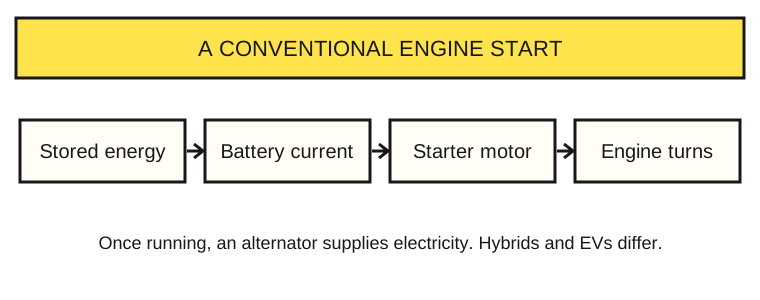
In a conventional combustion car, the starter battery stores electrical energy. The starter motor uses it to turn the engine during starting. Once the engine runs, an alternator turns mechanical energy into electricity for vehicle equipment and battery charging. These parts share a system but perform different jobs.
Starting needs a brief supply of substantial electrical power
A stopped combustion engine cannot yet power itself through repeated combustion. A starter motor turns it so the starting process can begin. The battery supplies the electrical energy for that motor. The battery also supplies equipment when the charging system is not providing enough electrical power.
A car that does not crank may have a discharged battery, poor connections, a starter fault, or another problem. ‘It will not start’ is an observation, not a battery diagnosis. A technician checks the starting system and the circumstances before deciding which part, if any, needs replacement.
Sources: DENSO Europe ↗ · DENSO Europe ↗
Generation replaces energy used by the electrical system
A conventional alternator takes mechanical power from the running engine and supplies electrical power. Its output serves loads such as lights, controls, and ventilation. Charging control manages the relationship between generation, electrical demand, and the battery.
A replacement battery must match the vehicle’s requirements. Some cars require particular battery technologies or a prescribed registration procedure after replacement. Check the exact service information. A successful jump start does not show why the battery was low or prove the charging system works correctly.
Sources: DENSO Europe ↗ · DENSO Europe ↗ · Toyota Motor Sales ↗ · VARTA Automotive / Clarios ↗
Common misunderstandings
The small auxiliary battery and the traction battery are not interchangeable. A low-voltage failure can prevent an electric car from operating even when its traction battery contains energy. Ask which battery a seller means when saying ‘the battery was replaced.’
Do not apply a generic jump-start procedure to every vehicle. Use the correct manual and assistance points for that model. A charging-system warning needs the response specified by the manufacturer; it is not simply a reminder that the battery has reached a particular age.
Sources: U.S. Department of Energy ↗ · DENSO Europe ↗ · Ford Motor Company ↗
Sources & review
Reviewed . Original educational explanation, checked against the sources below. This is general guidance; consult the documents for the exact vehicle, year, configuration, and market.
- StartersDENSO Europe · How starters work; Fault finding. Installation instructions are not reproduced. · Accessed 2026-10-22.
- Alternator technology: powered by changeDENSO Europe · Opening technical explanation: mechanical-to-electrical conversion and battery support · Accessed 2026-10-22.
- Basic Car Maintenance Tips & Services ChecklistToyota Motor Sales · 10. Inspect Your Belts and Hoses; 13. Replace Your Engine Air Filter; 14. Check Your Spark Plugs. Generic intervals and unqualified fuel-economy claims are not adopted. · Accessed 2026-10-22.
- How do I change an EFB or AGM battery?VARTA Automotive / Clarios · Approved replacement batteries and battery-management registration; procedures vary by vehicle · Accessed 2026-10-22.
- Buying a Used Car From a DealerFederal Trade Commission · Do Some Homework; Get an Independent Inspection Before You Buy; The Buyers Guide · Accessed 2026-10-22.
- How Do All-Electric Cars Work?U.S. Department of Energy · Alternative Fuels Data Center · Introduction and Key Components of an All-Electric Car · Accessed 2026-10-22.
- How Do Hybrid Electric Cars Work?U.S. Department of Energy · Alternative Fuels Data Center · Introduction, Electric generator, and Transmission · Accessed 2026-10-22.
- Instrument Cluster — Warning Lamps and IndicatorsFord Motor Company · online owner manual · Warning Lamps and Indicators; Engine Oil Warning Lamp; Malfunction Indicator Lamp; Scheduled Maintenance Indicator Lamp · Accessed 2026-10-22.