The short answer
Some manufacturers specify different maintenance for particular operating conditions. Examples can include frequent short journeys, extensive idling, dust, or towing. The definitions and affected tasks depend on the vehicle. Use the exact schedule to decide whether your pattern of use changes its requirements; do not invent a universal severe-service interval.
Distance alone does not describe all engine use
A car can accumulate operating time while traveling little distance. Repeated short journeys can also end before the engine reaches its intended temperature. In one Ford schedule, extensive idling and short trips are examples that can trigger particular additional requirements. That is an example to check against, not a schedule for every car.
Different conditions can affect different components. Dust may raise an air-filter question, while towing may introduce other checks. A manufacturer can specify a changed task, an extra inspection, a time condition, or a different interval. The appropriate response is to follow the applicable instructions rather than simply changing engine oil more often and ignoring everything else.
Sources: Ford Motor Company, online owner manual ↗ · Ford UK ↗
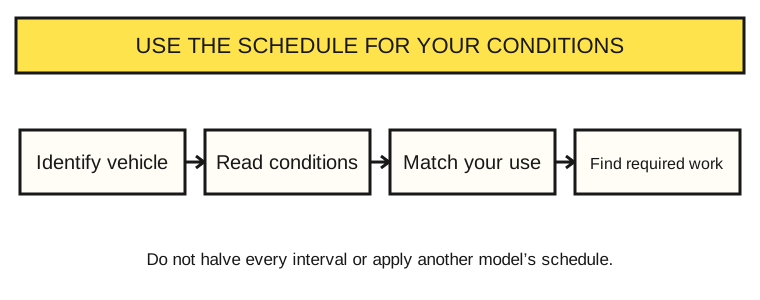
Find the definitions before choosing a schedule
Locate the maintenance information for the model year, engine or powertrain, and market. Read notes as well as the main table. A heading such as normal, special operating conditions, or severe service has meaning only within that manufacturer’s instructions.
Check how frequently the condition must occur and which services it changes. Occasional towing may be treated differently from regular towing. If your use is hard to classify, describe it to a qualified service adviser and request an explanation tied to the manufacturer’s documentation. Keep that answer with your maintenance plan.
Sources: Ford Motor Company, online owner manual ↗ · Ford UK ↗
Common misunderstandings
Severe does not necessarily mean racing or visible abuse. A routine pattern of ordinary journeys can fit a manufacturer’s special-condition definition. Conversely, the word does not authorize a workshop to apply an unexplained extra service to every vehicle.
There is no universal rule to halve every interval. A battery-electric car also has its own maintenance information even though engine-oil requirements do not apply. Identify the fitted components and the relevant operating conditions, then record the required work, timing, and source of each instruction.
Sources: Ford Motor Company, online owner manual ↗ · U.S. Department of Energy ↗ · Ford UK ↗
Sources & review
Reviewed . Original educational explanation, checked against the sources below. This is general guidance; consult the documents for the exact vehicle, year, configuration, and market.
- Scheduled Maintenance — Special Operating Conditions Scheduled MaintenanceFord Motor Company, online owner manual · Operating-condition examples; tasks differ by condition. Vehicle-specific intervals not reproduced. · Accessed 2026-10-23.
- Service Intervals and Oil Change IntervalsFord UK · When should I get my car serviced?; variable oil service intervals · Accessed 2026-10-22.
- Buying a Used Car From a DealerFederal Trade Commission · Do Some Homework; Get an Independent Inspection Before You Buy; The Buyers Guide · Accessed 2026-10-22.
- Vehicle Cost CalculatorU.S. Department of Energy · Alternative Fuels Data Center · Vehicle comparison inputs; cost assumptions and total ownership cost · Accessed 2026-10-22.
- Maintenance and Safety of Electric VehiclesU.S. Department of Energy · Alternative Fuels Data Center · Maintenance Comparison and Battery Maintenance · Accessed 2026-10-22.