The short answer
A vehicle identification number, or VIN, helps connect a particular car to its records. Use the relevant manufacturer or regulator’s recall service for that market. Read both the result and the lookup’s coverage limits before drawing a conclusion.
Begin with the vehicle’s identity
A model name can cover many engines, years, and equipment combinations. A VIN identifies a particular vehicle more precisely. On many modern cars it is visible near the lower edge of the windshield and appears in registration records. Use the actual car’s identifier rather than relying only on an advertisement.
Compare the identifier with the documents you are given. Ask about unexplained differences before continuing. This matching step organizes your evidence; it is not a complete title, ownership, or fraud check. Those questions need the appropriate official records and procedures in the vehicle’s market.
Sources: National Highway Traffic Safety Administration ↗ · Federal Trade Commission ↗
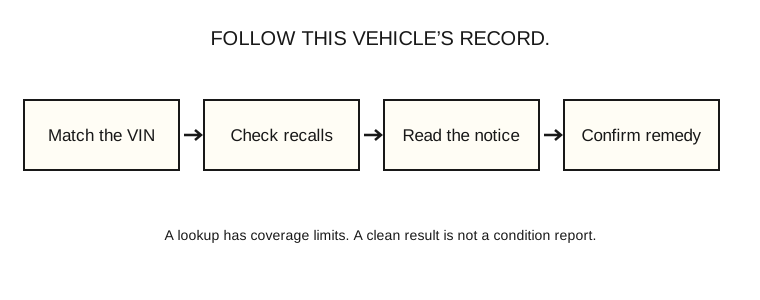
Read what the lookup actually covers
For U.S.-market vehicles, the National Highway Traffic Safety Administration, or NHTSA, offers a recall lookup. A VIN search can show unrepaired safety recalls for participating manufacturers. A search by make, model, and year provides broader model information; it does not establish the same vehicle-specific result.
NHTSA explains that its VIN lookup does not show every kind of record. Limits include completed repairs, some newly announced recalls, many recalls older than 15 years, some manufacturers, non-safety campaigns, and international vehicles. A result without an open recall is therefore a defined database result, not proof of a flawless history.
Common misunderstandings
A recall search does not replace maintenance records, a vehicle-history report, or an independent inspection. Each answers a different question. A completed recall does not establish that unrelated components are healthy.
Finding a recall for a model does not automatically prove that every example is affected. Conversely, a recently announced campaign may not yet show against every affected VIN. Follow the manufacturer’s current instructions and repeat the check when new information appears.
Sources: National Highway Traffic Safety Administration ↗ · Federal Trade Commission ↗
Sources & review
Reviewed . Original educational explanation, checked against the sources below. This is general guidance; consult the documents for the exact vehicle, year, configuration, and market.
- Check for RecallsNational Highway Traffic Safety Administration · What will / won’t the license plate and VIN search show? · Accessed 2026-10-22.
- Buying a Used Car From a DealerFederal Trade Commission · Do Some Homework; Get an Independent Inspection Before You Buy; The Buyers Guide · Accessed 2026-10-22.