The short answer
Many modern diesels use several exhaust-treatment stages. A diesel particulate filter, or DPF, catches soot. Selective catalytic reduction, or SCR, treats nitrogen oxides using a separate exhaust fluid where fitted. These systems do different jobs. Their operating conditions and maintenance needs should be part of a buying decision.
Soot and nitrogen oxides need different treatment
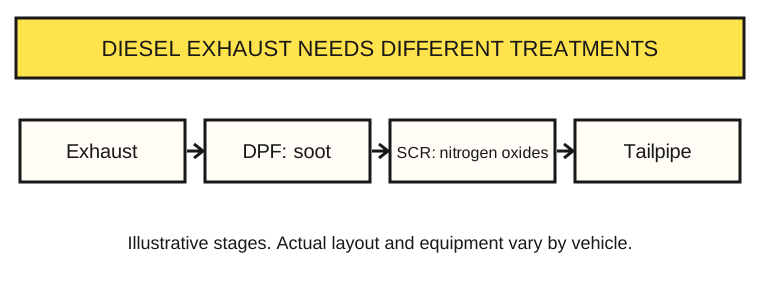
Diesel combustion produces several pollutants. Soot is particulate material, meaning small particles. A particulate filter catches this material as exhaust passes through it. A separate oxidation catalyst may also form part of the treatment assembly. The fitted equipment depends on the engine and its emissions specification.
Nitrogen oxides are gases rather than the soot held by a filter. In a typical SCR system, dosing exhaust fluid into hot exhaust supports reactions that reduce these gases. A particulate filter and SCR are therefore complementary devices, not two names for the same component.
Sources: U.S. Department of Energy ↗ · Cummins ↗
Capturing soot creates a need to manage it
A filter cannot collect soot indefinitely without removing it. Regeneration uses suitable conditions to oxidize accumulated soot. The vehicle controls this process, and its requirements differ by model. Do not assume that any short journey or any high-speed drive completes it.
Read the exact manual’s instructions for warnings and interrupted regeneration. Some patterns of use can make the required conditions difficult to achieve. A workshop may need to investigate the underlying cause rather than simply repeating a cleaning procedure. Never improvise a stationary regeneration or ignore hot-exhaust precautions.
Regeneration removes soot, but it does not remove all non-combustible ash. Ash can require a separate service under the system?s instructions. A completed regeneration therefore does not mean a filter has returned to new condition.
Sources: U.S. Environmental Protection Agency ↗ · Cummins ↗
Common misunderstandings
A filter regeneration and an exhaust-fluid refill address different needs. Filling the fluid tank does not remove soot from the particulate filter. Equally, a completed regeneration does not establish that every SCR sensor, pump, and catalyst works correctly.
A diesel badge does not specify all of its exhaust equipment. Model year, engine version, and market matter. Do not use a generic driving recipe or a universal cleaning interval. Find the manufacturer’s instructions and ask what evidence supports any proposed repair, especially when the same warning has returned.
Sources: Cummins ↗ · U.S. Department of Energy ↗ · Ford UK ↗
Sources & review
Reviewed . Original educational explanation, checked against the sources below. This is general guidance; consult the documents for the exact vehicle, year, configuration, and market.
- How Do Diesel Vehicles Work?U.S. Department of Energy · Alternative Fuels Data Center · Introduction and Key Components of a Light-Duty Diesel Vehicle · Accessed 2026-10-22.
- How an Aftertreatment System WorksCummins · Diesel particulate filter and selective catalytic reduction; promotional near-zero claims not adopted. · Accessed 2026-10-22.
- Technical Bulletin: Diesel Particulate Filter Operation and MaintenanceU.S. Environmental Protection Agency · Filter Regeneration; Filter Cleaning. Historical retrofit bulletin used only for mechanisms and soot-versus-ash distinction, not current rules or universal intervals. · Accessed 2026-10-22.
- Buying a Used Car From a DealerFederal Trade Commission · Do Some Homework; Get an Independent Inspection Before You Buy; The Buyers Guide · Accessed 2026-10-22.
- DEF Facts — The Facts About the FluidCummins · Fluid composition and storage in a separate tank; no service interval generalized · Accessed 2026-10-22.
- Service Intervals and Oil Change IntervalsFord UK · When should I get my car serviced?; variable oil service intervals · Accessed 2026-10-22.